Academic Experience

Nanjing University of Posts and Telecommunications (NUPT)
Advisor: Lei Chen
- Weighted average: 89.1/100.
- GPA: 3.91/5.0; WES-evaluated GPA: 3.82/4.0.
- TOEFL: 103. GRE: 336.
- Research interests: evidential deep learning, uncertainty quantification, and reinforcement learning.

University of Cambridge
- Short-term academic training focused on modern AI foundations and applications.

Yale University
- M.S. student in Biostatistics (Data Science Track).
Industry Experience

Algorithm Intern · Baidu
Improved a production dual-encoder retrieval system by systematically analyzing key failure modes and contributing across post-training strategy design, data construction, and offline evaluation.
- Systematically analyzed failure modes including term omission, term mismatch, semantic misunderstanding, and relevant-but-not-answerable results to guide retrieval optimization.
- Developed a hard-negative enhancement framework based on mis-retrieved samples, together with negative loss reweighting and staged optimization, improving average Recall by ~10.5%.
- Built an LLM-driven data augmentation framework with two major categories—q+u→q and u→q—covering four sub-pipelines for query–URL constrained semantic transfer and content-driven retrieval scenarios, yielding a further ~3.2% improvement in average Recall.
- Introduced an offline LLM + rule-based teacher scoring mechanism for fine-grained supervision over candidate URL sets, and leveraged it for post-training and listwise optimization of the dual-encoder, driving an additional ~6.0% gain in average Recall.
- Increased overall average Recall from ~60 to 72.5, corresponding to a cumulative relative improvement of ~20.8%, and established a full optimization loop spanning failure analysis, data construction, training paradigm refinement, and offline evaluation.

Algorithm Intern · HONOR
Built Generative Engine Optimization (GEO) strategy and evaluation infrastructure for HONOR 400 and Magic V5, connecting LLM-driven content generation with measurable gains in recommendation and citation visibility.
- Owned GEO strategy deployment and experiment-platform construction for HONOR 400 and Magic V5. Abstracted LLM web-search behavior (e.g., DeepSeek) into a two-stage pipeline—candidate retrieval and re-ranking—and analyzed the key drivers behind citation and recommendation using BM25, semantic similarity, and related signals.
- Proposed and independently implemented a Multi-Agent Consistency Controller: a generation agent drafted promotional copy, while a review agent automatically detected factual errors and exaggerated claims, returned structured feedback, and enabled multi-round self-correction to reduce hallucination and compliance risk while preserving factual consistency and brand tone at scale.
- Designed a GAN-like three-stage workflow spanning generation, adversarial posterior evaluation, and prior scoring. Built a multi-agent system for large-scale copy generation; wrote headless-browser scripts to query LLMs, collect Top-50 reference lists, and track Top-10 citation coverage and Top-50 candidate coverage; and constructed a query–document dataset with LLM Top-5 candidates as positives and traditional SEO documents as negatives.
- Fine-tuned DeepSeek-8B with LoRA to learn a scoring function for LLM citation probability. In offline evaluation, the model achieved AUC ≈ 0.88 for predicting whether a document would be used as a high-weight reference, Top-5 hit rate above 80%, and Spearman correlation of ~0.7 between prior scores and real online exposure.
- Using unified prior and posterior metrics to iteratively refine generation and content-selection strategies, increased the share of HONOR 400 / Magic V5 content proactively recommended or cited by LLMs by ~3× (key-query recommendation rate from ~20% to 70%+), maintained overall visibility above 65%, reduced weekly publication volume from ~100 pieces to 5–6, and translated the efficiency gain into roughly RMB 4 million in annual marketing cost savings.

Algorithm Intern · Bosch
Developed data-driven automation for Ethernet gateway tooling and protocol-level validation.
- Designed rule-based automated decision algorithms and built a gateway intelligent system to reduce system error rates.
- Implemented a core parsing engine that auto-generates C++ protocol parsing code and an automated test framework.
- Completed Python implementations of RTP/RTSP/RTCP and studied IEEE1588/gPTP for time synchronization.
- Optimized a lightweight protobuf library and improved accuracy from 98.4% to 100%.

Algorithm Intern · Industrial and Commercial Bank of China (ICBC)
Built ML-based credit and risk assessment prototypes with structured data pipelines.
- Integrated multi-source customer data and standardized preprocessing workflows for consistency and availability.
- Designed an intelligent loan issuance assessment model reaching ~72% accuracy.
- Developed an LSTM–Transformer time-series model achieving ~89% AUC and early risk identification.
Publications
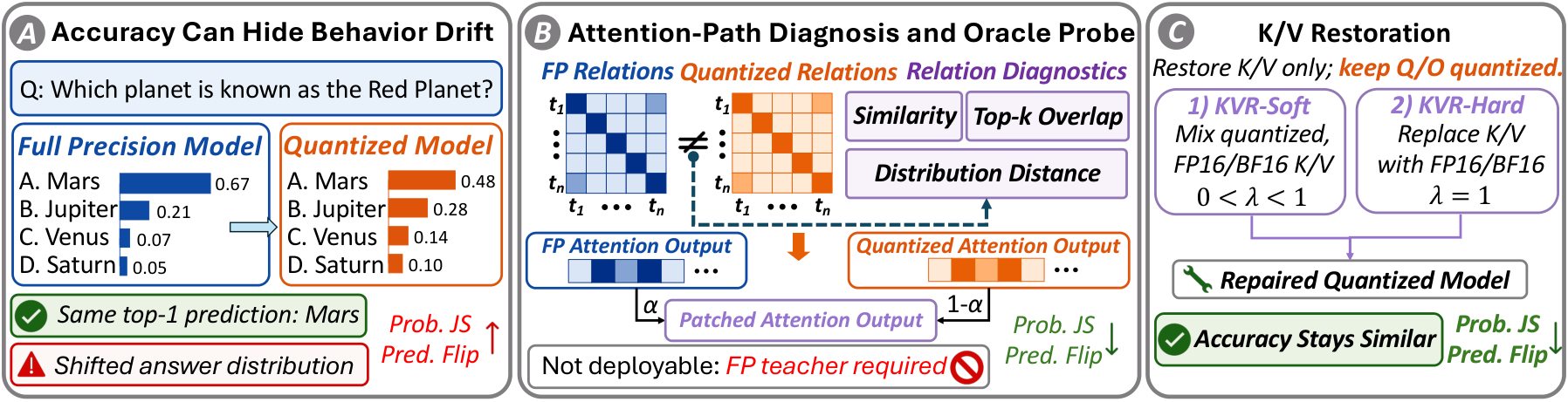
K/V Restoration: A Training-Free Repair for Uncertainty-Behavior Drift in Quantized Language Models
A training-free mixed-precision repair that restores only K/V projections to reduce quantization-induced uncertainty-behavior drift while keeping the remaining backbone quantized.
Show abstract
Weight-only post-training quantization is commonly evaluated by accuracy or perplexity, yet similar aggregate performance can conceal changes in candidate distributions, confidence, and decisions relative to the full-precision model. We study this uncertainty-behavior drift through a diagnosis-to-repair analysis. Realized attention-relation mismatch provides a complementary diagnostic for candidate-distribution drift, and an attention-output intervention localizes repair potential to the attention path. Component-level interventions then identify the key and value (K/V) projections as the dominant tested local target within this path. We propose K/V Restoration, a training-free mixed-precision repair that restores only the key and value projections while leaving the remaining backbone quantized. KVR-Soft interpolates quantized and higher-precision K/V states, whereas KVR-Hard directly replaces the quantized K/V projections; neither requires a full-precision forward pass at inference. Across ten GPTQ-quantized models and nine candidate-scoring benchmarks, both variants reduce candidate-distribution divergence and prediction flips by about 16% and 11% relative to the matched GPTQ backbone on the three main benchmarks, with comparable accuracy. The gains persist across six calibration bases, improve selective-prediction fidelity, and are not reproduced by controls under the same K/V budget cap. These results support behavioral fidelity as a compression objective beyond accuracy and identify targeted K/V restoration as a practical repair.
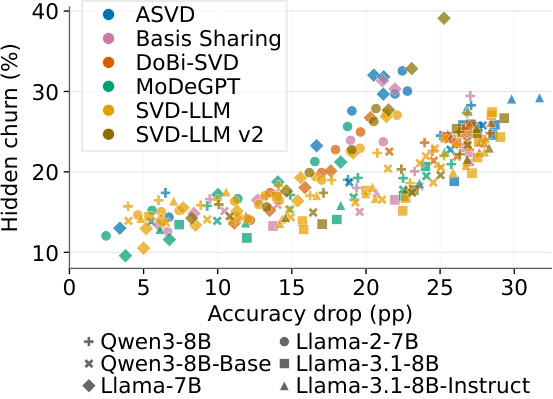
Accuracy Is Not Fidelity: Decision Churn in Low-Rank Compressed Language Models
A large-scale audit showing that similar aggregate accuracy can conceal substantial per-example decision churn in low-rank compressed language models.
Show abstract
Low-rank compression of large language models is typically evaluated using perplexity, aggregate accuracy, and matrix reconstruction error. These metrics do not determine whether a compressed model preserves the per-example decisions of its dense source, a property we call dense-reference decision fidelity. We audit 235 compressed checkpoints spanning 6 dense sources, 14 low-rank method variants, and 7 candidate-scoring tasks, measuring prediction flips and hidden churn, defined as the flip rate minus the absolute change in aggregate accuracy. Across the suite, compressed accuracy decreases by 19.07 percentage points on average, while 39.22% of selected answers change and HiddenChurn averages 20.15%. Among 216 cross-method checkpoint pairs sharing the same dense source and matched within 0.5 percentage points in absolute accuracy change, prediction-flip rates differ by 2.27 percentage points on average and by up to 6.97 points. Across the five release-defined keep labels, mean PredFlip and HiddenChurn decline but remain substantial at 0.8: 27.40% of predictions flip and HiddenChurn remains 15.57%. A local first-order analysis shows that reconstruction magnitude alone does not determine decision-sensitive error; the effect depends on residual alignment with score-gap sensitivities and the dense margin. We introduce the boundary-amplification ratio (BAR), a post-hoc measure of the largest competitor-relative score shift divided by the dense margin. For a unique dense winner, BAR < 1 certifies prediction preservation. These findings support treating dense-reference decision fidelity as a distinct evaluation target alongside standard compression metrics.
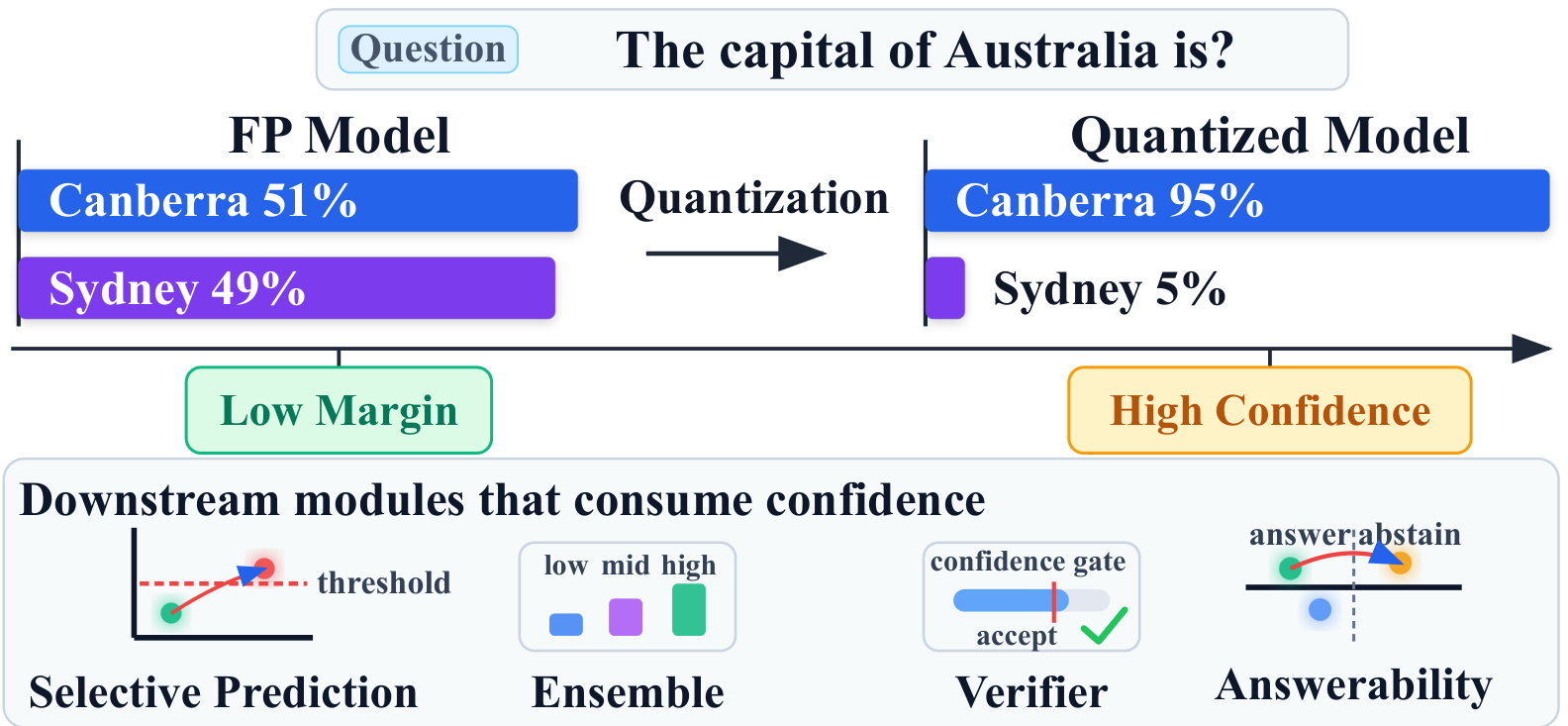
Target-Aware Calibration Data Selection for Preserving Uncertainty in Quantized Language Models
A target-aware calibration-data selection framework for preserving confidence, margins, and answerability behavior in quantized language models.
Show abstract
Quantization is widely used to deploy large language models, but its effect on uncertainty behavior, such as confidence, margins, and abstention, is rarely treated as a primary objective. We frame calibration-data selection for quantization as a target-dependent uncertainty-preservation problem. Different deployments emphasize different regions of the input distribution, yet prior work mainly optimizes accuracy-oriented compression metrics or adjusts scores after quantization. We formalize this goal with distributional and boundary preservation risks, and provide a simple mixture-mismatch argument explaining why no single calibration recipe should be expected to fit all targets. We introduce Doubt-Preserving Quantization (DPQ), a lightweight pre-quantization recipe family that uses full-precision predictions to construct target-aligned calibration mixtures of high-doubt examples and generic anchors. Across 8 language models, 9 NLP benchmarks, and 22 comparison methods, the leading fixed recipe changes with the preservation target: DPQ-r75 leads on SQUAD2 answerability-boundary preservation, while milder or single-signal variants, including DPQ-r50, confidence-only, and entropy-only, better preserve broad multiple-choice QA behavior. These results show that calibration data should be selected for the specific full-precision score behavior a deployment needs to preserve, rather than treated as a fixed quantization detail. Code is available at https://github.com/xi-xiaoran/DPQ.
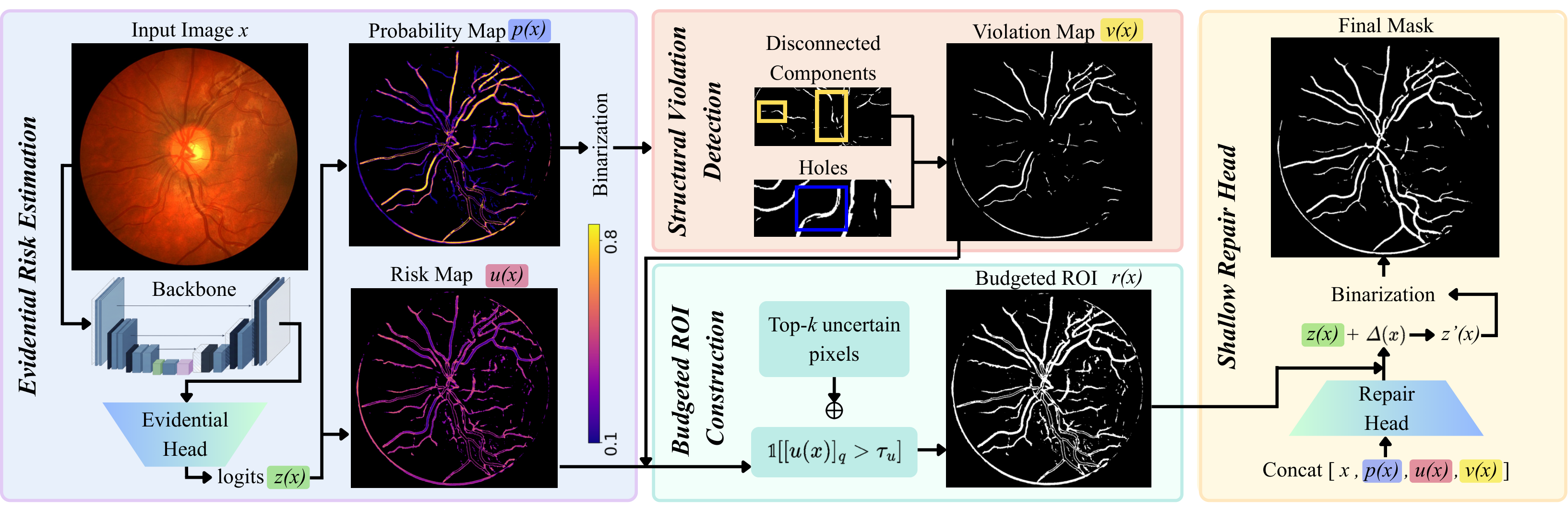
Risk-Aware Structural Repair for Topology-Sensitive Image Segmentation
A lightweight post-hoc framework that combines evidential uncertainty and structural violations to localize and repair topology-sensitive segmentation errors within a risk-guided region of interest.
Show abstract
Topology-sensitive segmentation masks can achieve high overlap yet contain disconnections, spurious components, or holes that compromise downstream analysis. Existing approaches commonly incorporate topological priors during training or refine predictions after segmentation, but localizing where corrections are needed remains challenging. We propose RASR, a Risk-Aware Structural Repair framework that freezes an evidentially trained backbone and localizes repair using two complementary signals: evidential uncertainty and structural violations. These signals define a risk-guided region of interest (ROI), where a shallow repair head applies gated residual logit updates while leaving predictions outside the ROI unchanged. Across five vessel and road benchmarks and four backbones, RASR improves overlap, boundary, and structural metrics with only 20.5K additional parameters. Ablations support the complementary roles of evidential uncertainty and structural violations, while cross-backbone experiments show partial transferability. Anonymous code is available at https://anonymous.4open.science/r/RASR-1BA0.
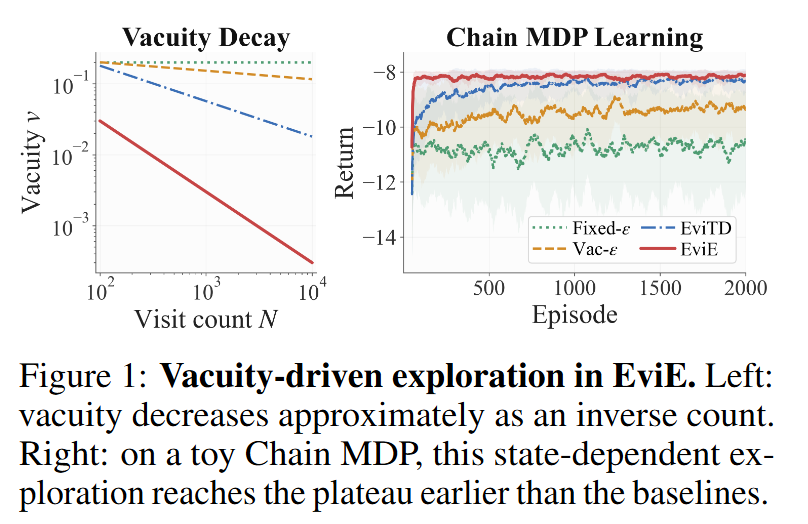
EviE: Evidential Exploration for Value-Based Reinforcement Learning
A state-dependent exploration framework that uses evidential vacuity to allocate exploration where local value decisions remain unstable.
Show abstract
Exploration in deep reinforcement learning (RL) is still often controlled by global heuristics such as ε-greedy or Boltzmann policies, which can over-explore familiar states while failing to sustain exploration where local decisions remain unstable. To address this, we propose Evidential Exploration (EviE), a value-based framework that uses Dirichlet vacuity as a state-dependent exploration signal. In tabular Markov decision processes (MDPs), EviE maintains additive action-wise evidence with a symmetric prior and uses the resulting vacuity to modulate a local ε-greedy policy. We prove that vacuity decays as 1/N(s) with state visitation, yielding a count-like exploration schedule that is greedy in the limit with infinite exploration and therefore preserves standard tabular Q-learning convergence guarantees. In deep RL, where explicit state counts are unavailable, we extend the same principle with a lightweight evidential head on top of a Deep Q-Network backbone and use its vacuity as a local exploration controller, without intrinsic bonuses or auxiliary exploration networks. Across tabular and deep benchmarks, EviE recovers the predicted inverse-count behavior, improves hard-exploration efficiency, and remains competitive on broader value-based RL tasks. We also provide preliminary evidence under the evaluated shifts.
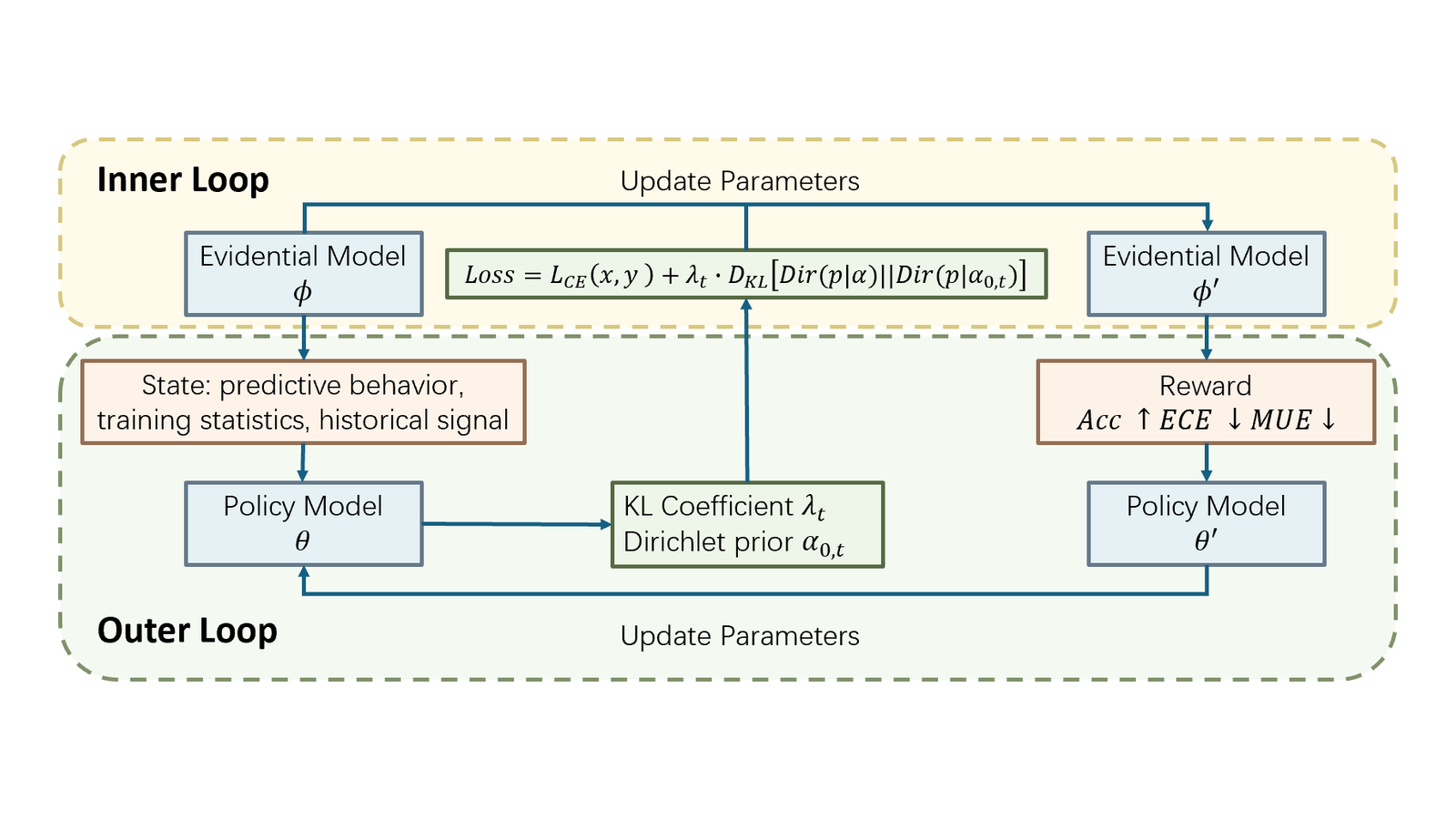
Bi-level Meta-Policy Control for Dynamic Uncertainty Calibration in Evidential Deep Learning
A bi-level meta-policy framework that dynamically optimizes KL regularization and learnable Dirichlet priors for robust uncertainty calibration.
Show abstract
Traditional Evidence Deep Learning (EDL) methods rely on static hyperparameter for uncertainty calibration, limiting their adaptability in dynamic data distributions, which results in poor calibration and generalization in high-risk decision-making tasks. To address this limitation, we propose the Meta-Policy Controller (MPC), a dynamic meta-learning framework that adjusts the KL divergence coefficient and Dirichlet prior strengths for optimal uncertainty modeling. Specifically, MPC employs a bi-level optimization approach: in the inner loop, model parameters are updated through a dynamically configured loss function that adapts to the current training state; in the outer loop, a policy network optimizes the KL divergence coefficient and class-specific Dirichlet prior strengths based on multi-objective rewards balancing prediction accuracy and uncertainty quality. Unlike previous methods with fixed priors, our learnable Dirichlet prior enables flexible adaptation to class distributions and training dynamics. Extensive experimental results show that MPC significantly enhances the reliability and calibration of model predictions across various tasks, improving uncertainty calibration, prediction accuracy, and performance retention after confidence-based sample rejection.
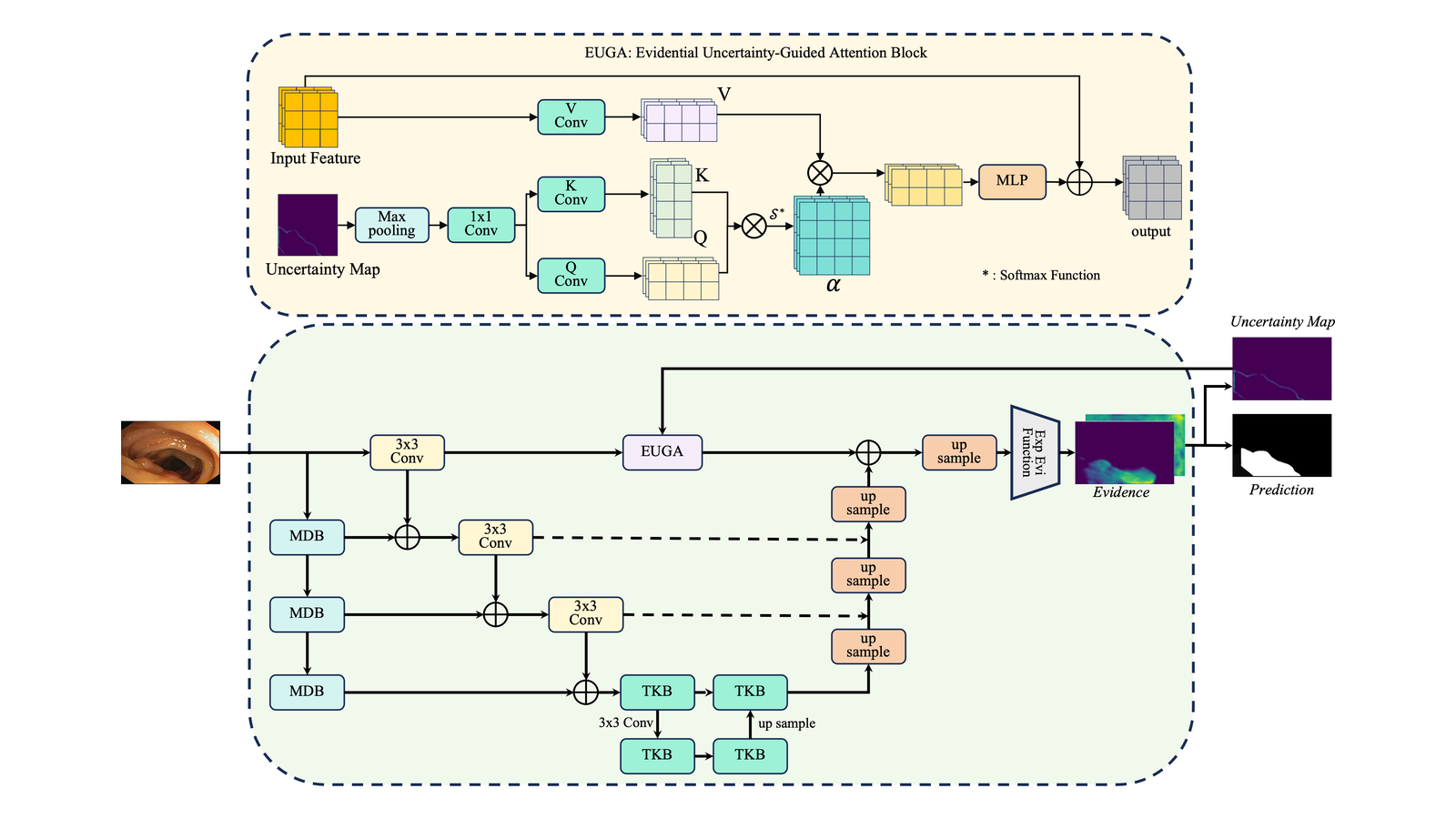
Progressive Uncertainty-Guided Evidential U-KAN for Trustworthy Medical Image Segmentation
A progressive uncertainty-guided attention framework that strengthens boundary awareness and preserves semantic evidence for reliable medical segmentation.
Show abstract
Trustworthy medical image segmentation aims at deliver accurate and reliable results for clinical decision-making. Most existing methods adopt the evidence deep learning (EDL) paradigm due to its computational efficiency and theoretical robustness. However, the EDL-based methods often neglect leveraging uncertainty maps rich in attention cues to refine ambiguous boundary segmentation. To address this, we propose a progressive evidence uncertainty guided attention (PEUA) mechanism to guide the model to focus on the feature representation learning of hard regions. Unlike conventional approaches, PEUA progressively refines attention using uncertainty maps while employing low-rank learning to denoise attention weights, enhancing feature learning for challenging regions. Concurrently, standard EDL methods suppress evidence of incorrect class indiscriminately via Kullback-Leibler (KL) regularization, impairing the uncertainty assessment in ambiguous areas and consequently distorts the corresponding attention guidance. We thus introduce a semantic-preserving evidence learning (SAEL) strategy, integrating a semantic-smooth evidence generator and a fidelity-enhancing regularization term to retain critical semantics. Finally, by embedding PEUA and SAEL with the state-of-the-art U-KAN, we proposes Evidential U-KAN, a novel solution for trustworthy medical image segmentation. Extensive experiments on 4 datasets demonstrate superior accuracy and reliability over the competing methods. The code is available at github.
Projects
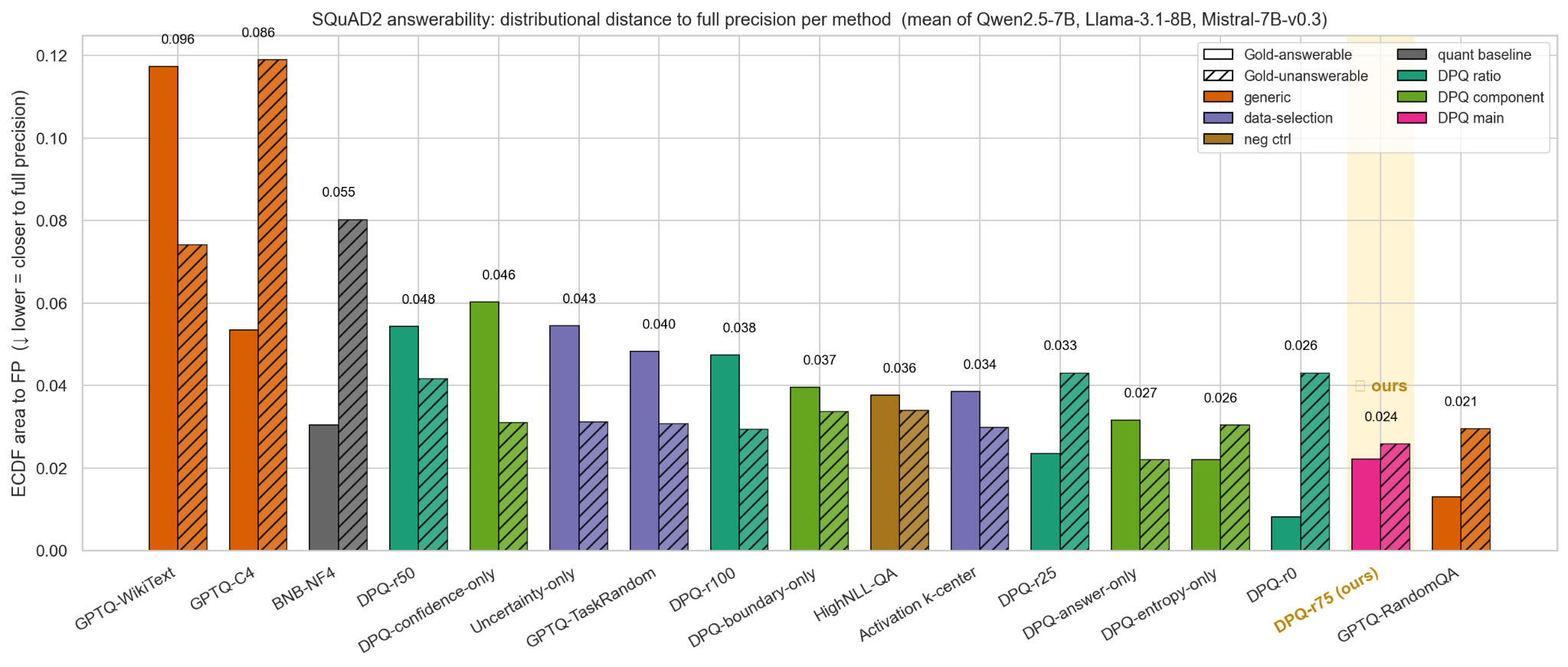
Doubt-Preserving Quantization (DPQ)
A target-aware pre-quantization calibration-data selection framework for preserving full-precision uncertainty behavior without modifying the quantizer or adding inference-time overhead.
Show more
Uses full-precision predictions to construct target-aligned calibration recipes from high-doubt or boundary-near examples and generic anchors.
The repository provides staged workflows for data preparation, calibration construction, GPTQ/AWQ quantization, evaluation, post-hoc checks, SQuAD2 distribution diagnostics, and reproducible summary generation.
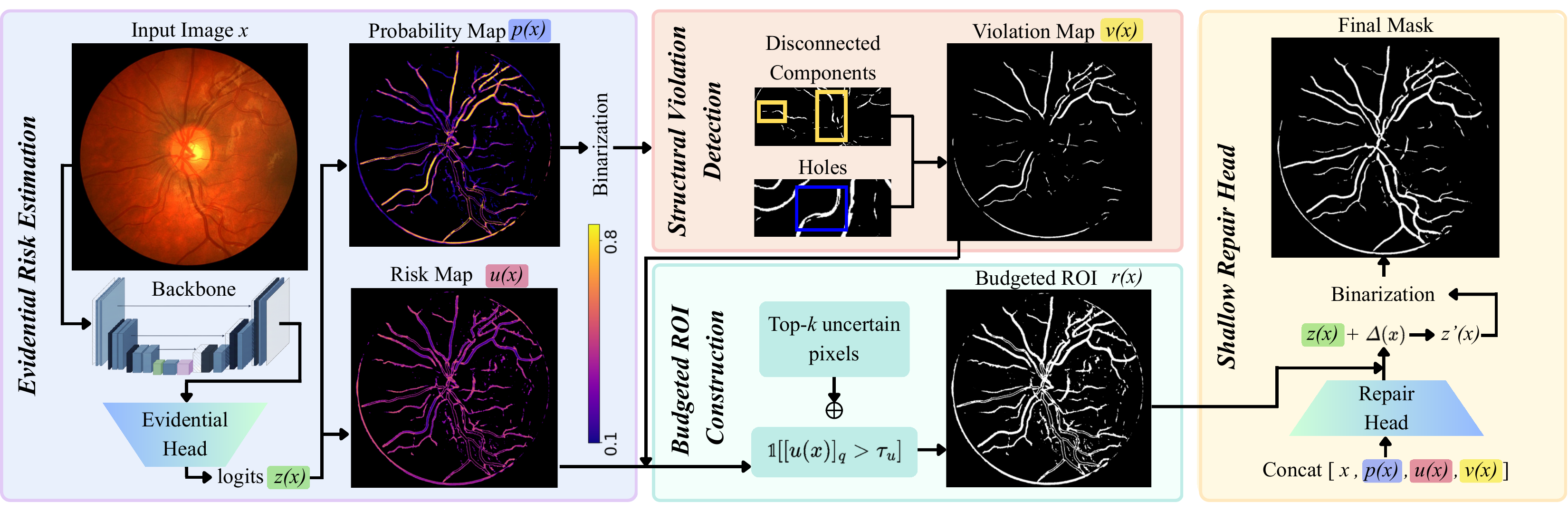
RASR
A lightweight post-hoc repair framework that combines evidential uncertainty and structural violations to localize and correct topology-sensitive segmentation errors.
Show more
An evidential backbone produces probability and uncertainty maps, while a structural certificate identifies violation regions. RASR feeds Concat[x, p(x), u(x), v(x)] to a shallow repair head and applies gated residual updates only inside a budgeted ROI.
The repository includes UNet, Attention-UNet, UNet++, and Swin-UNet backbones; vessel and road benchmarks; ROI/gate, budget, transfer, and threshold ablations; and reproducible aggregation scripts.
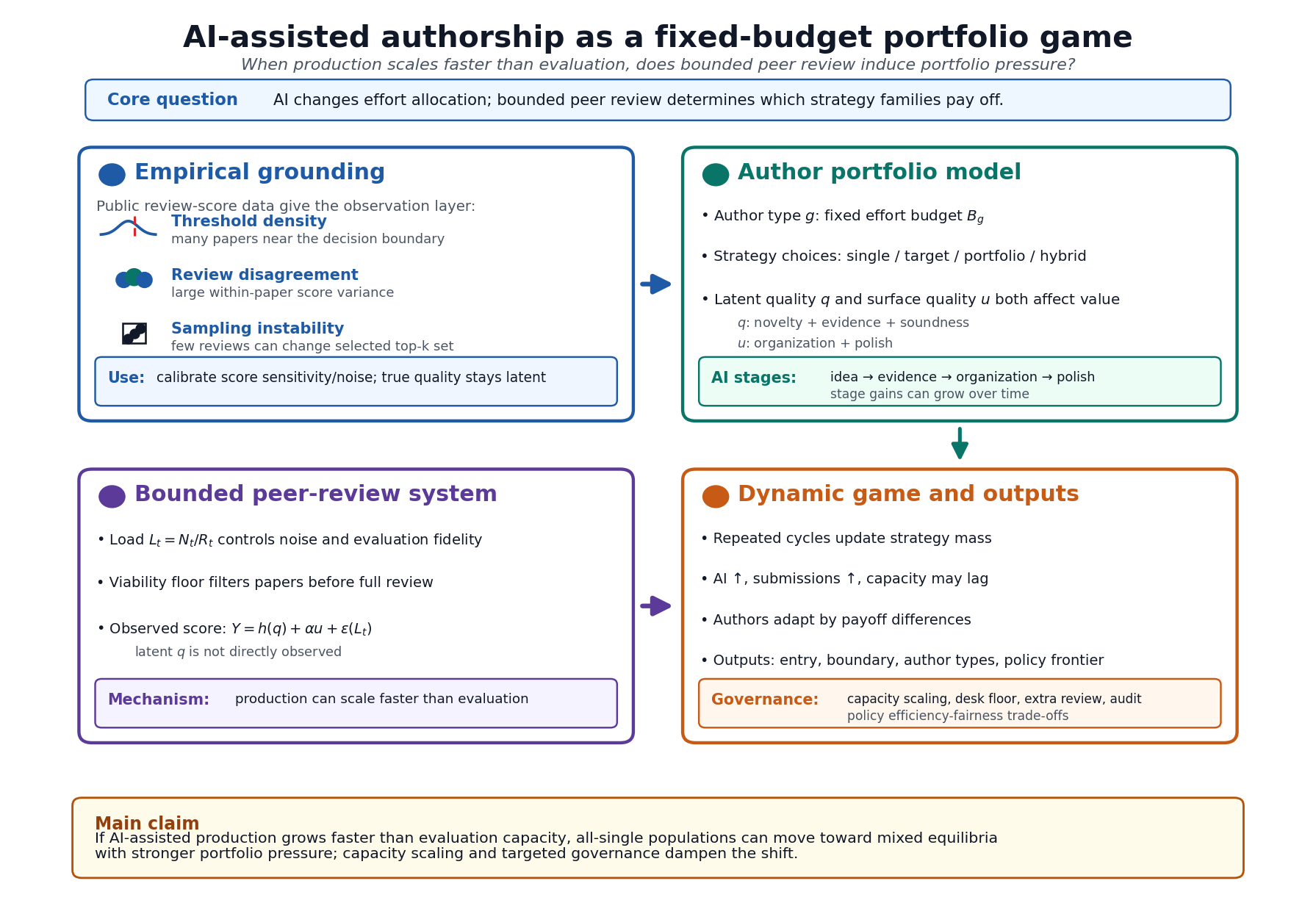
Bounded Review Simulation
A reproducible simulation artifact for studying when AI-assisted scientific production creates portfolio pressure under bounded review capacity and which controls change the boundary.
Show more
Separates latent scientific quality from observed review scores and models fixed-budget author strategy families, heterogeneous author groups, shared review capacity, and accept/oral/best-paper-style quotas.
The artifact also includes reviewer-side overload, reliability heterogeneity, AI-assisted reviewing, assignment noise, strategic bidding, and governance/falsification controls, with quick, manuscript-scale, and full 50-seed reproduction workflows plus cached CSV and figure snapshots.

CP31 Ticket Snatcher
An automation toolkit designed to improve the success rate of convention ticket purchasing under heavy competition.
Show more
Built for real-world ticketing bottlenecks such as queue congestion and rapid sell-out scenarios.
Designed as a practical automation toolkit for anime convention ticket purchasing under extreme contention.
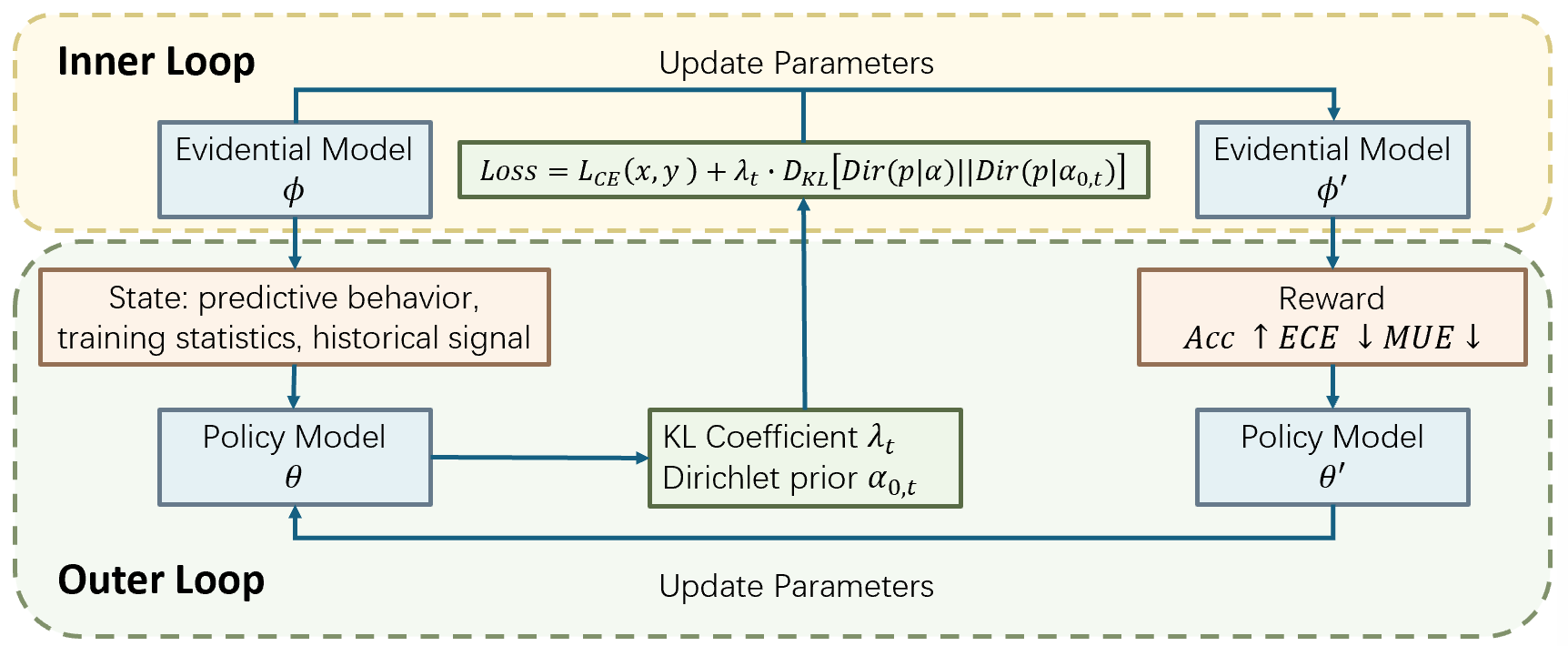
Meta-Policy Controller (MPC)
A bi-level meta-policy system that learns dynamic uncertainty calibration strategies for evidential models.
Show more
Uses a policy network to optimize KL coefficients and class-wise Dirichlet prior strengths. Aims to unify accuracy and uncertainty quality under a single adaptive optimization framework. Serves as the codebase accompanying the arXiv preprint.
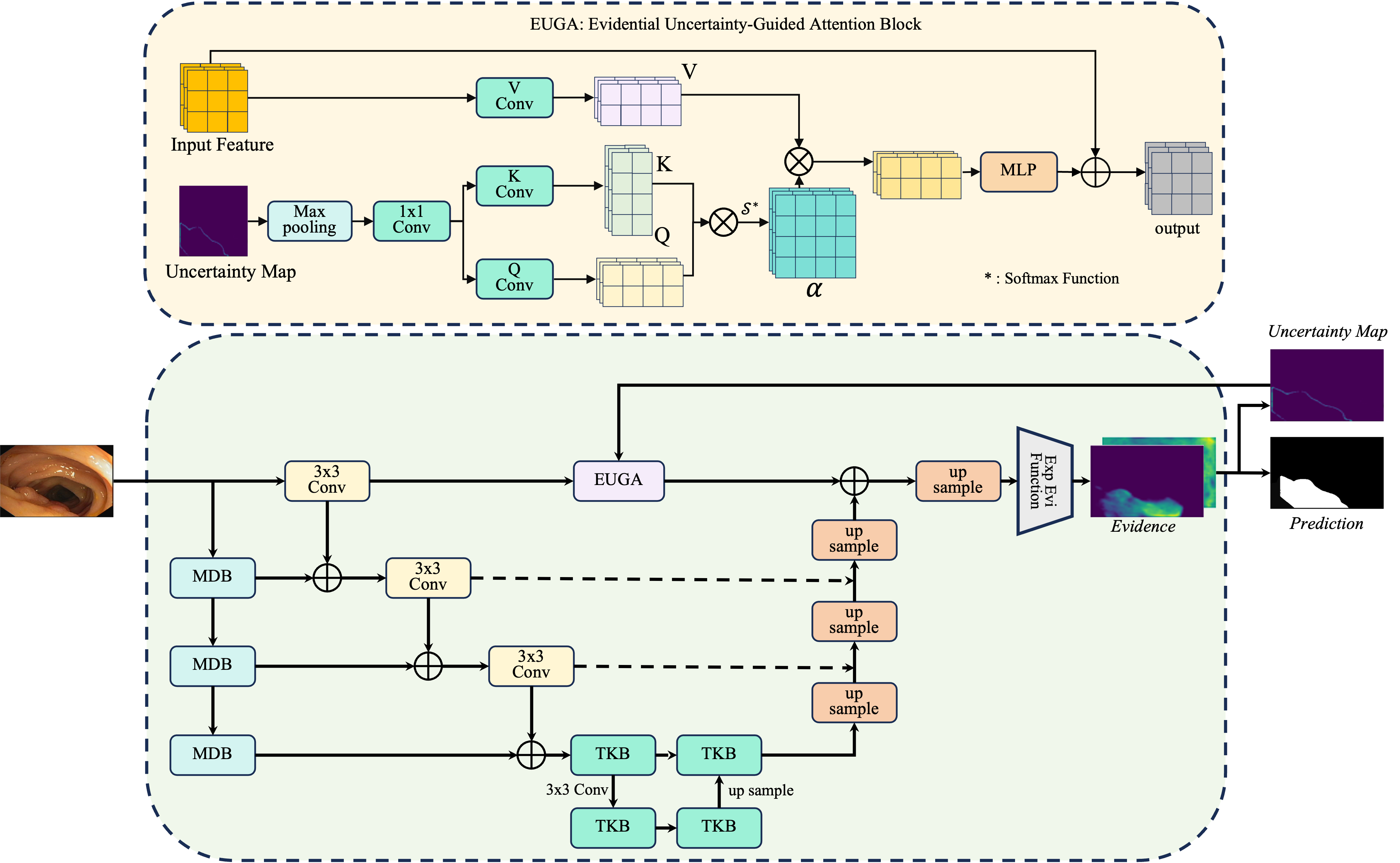
Evidential U-KAN
A trustworthy medical segmentation framework integrating progressive uncertainty-guided attention and semantic-preserving evidence learning.
Show more
Combines PEUA and SAEL to enhance boundary precision and preserve clinically meaningful semantics. Demonstrates strong accuracy–reliability trade-offs across multiple public polyp datasets. Serves as the codebase accompanying the arXiv preprint.
Life Updates

Hearthstone Americas Top 5
Reached Rank

Mahjong Soul Rank-Up
Reached Saint rank in 4-player ranked matches.

StarCraft II Milestone
Achieved Master League as Zerg.
Fun Stuff
Random Anime Buddy
A tiny gacha that refreshes your mood. New buddy on every reload.
Loading...